
The Future of Luxury Aviation
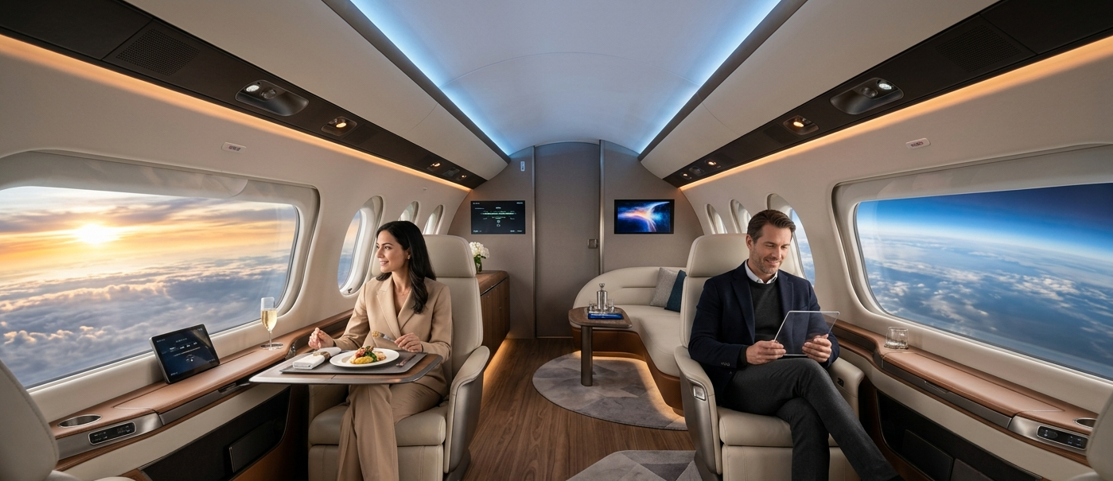
"From zero-emission supersonic jets to AI-driven biomimetic cabins, the next era of high-end flight is trading gold-plated opulence for sustainable, hyper-personalized wellness."
The golden age of aviation was defined by white-glove service, champagne fountains, and spacious lounges. For decades, "luxury" in the skies meant replicating five-star land hotels inside a metal tube. However, a quiet revolution is taking place at 40,000 feet. The future of luxury aviation is no longer about heavy mahogany veneers or gold-plated fixtures; it is being redefined by three core pillars: absolute sustainability, biometric wellness, and hyper-personalized time optimization.
Here is how the next decade will transform premium travel for the world's most discerning flyers.
1. The Return of Supersonic (and Sustainable) Speed
For the ultra-wealthy, the ultimate luxury is time. Since the retirement of the Concorde, supersonic commercial flight has been absent from our skies. That is about to change.
A new fleet of aerospace startups and established giants are developing Mach 1.7 to Mach 2.0 aircraft designed to cut transatlantic flight times in half. What makes this new era distinct from the past is the commitment to the environment. The next generation of luxury jets is being engineered from the ground up to run entirely on Sustainable Aviation Fuel (SAF) and net-zero carbon propulsion systems, proving that extreme speed does not have to come with an extreme carbon footprint.
2. Biomimetic Cabins and Wellness Infrastructure
Step inside the luxury cabin of tomorrow, and you won't find traditional row structures. Designers are pivoting toward biomimetic architecture, interiors inspired by natural forms that maximize acoustic comfort and psychological well-being.
- Circadian Lighting Arrays: Instead of simple mood lighting, cabins will feature full-spectrum LED ceilings that mirror the precise light frequency of your destination, eliminating jet lag before you touch down.
- Air Purification Zones: Utilizing advanced HEPA and ionization technologies, cabin air will be completely refreshed every two minutes, infused with subtle, stress-reducing organic terpenes.
- Active Noise-Canceling Shells: Micro-microphones embedded in the cabin walls will emit inverse sound waves, turning the traditional roar of jet engines into a near-silent sanctuary.
3. The AI Concierge at 40,000 Feet
The future first-class suite is an adaptive ecosystem. Integrated artificial intelligence will continuously monitor passenger biometrics via subtle sensors in the seating fabrics.
If the system detects slight dehydration, a flight attendant is subtly alerted to bring an electrolyte-infused beverage. If a passenger's body temperature drops, the seat's micro-climatic zones automatically adjust. Entertainment will transition from simple screens to immersive augmented reality (AR) environments, allowing travelers to conduct boardroom meetings or relax in a virtual alpine meadow mid-flight.
"Luxury is no longer about what you can see and touch; it’s about how you feel when you step off the aircraft."
The Path Forward
As commercial airlines expand their ultra-premium "residence" concepts and private aviation embraces hybrid-electric propulsion, the boundaries of flight are expanding. The future of luxury aviation promises a seamless, guilt-free blending of engineering excellence and human-centric design, ensuring the journey is just as anticipated as the destination.
Frequently Asked Questions
Will supersonic private jets replace subsonic aircraft like the Gulfstream G650?
Not immediately. New supersonic aircraft in development target Mach 1.7 to Mach 2.0 using sustainable aviation fuel, but they're still in development rather than available for charter today. Current SPH Services aircraft such as the Gulfstream G650 cruise at up to Mach 0.925, making today's long-range heavy jets still the practical choice for global charter.
What is a biomimetic cabin in private aviation?
A biomimetic cabin uses interior design inspired by natural forms rather than traditional row seating, aimed at improving acoustic comfort and passenger wellbeing. Examples discussed include circadian lighting that mirrors your destination's light cycle and active noise-cancelling cabin walls, both still emerging rather than standard on current aircraft.
Are AI concierge systems already used on private jets today?
Not yet as standard. The biometric monitoring and AI concierge features described are part of the next generation of cabin design still in development. Current aircraft in the SPH Services fleet, such as the Bombardier Global 7500, instead rely on features like Nuage seating and a dedicated Master Suite for passenger comfort.